
 Welcome to my world: cuisine, trends, well-being,... and I decided to share all this with you!





Have you heard of L-tryptophan? I hadn’t, until someone told me about its benefits for mood, stress and even digestion. I was curious, so I tried it.
Today, I’m sharing my experience with you. This isn’t a partnership, just a genuine favourite: a supplement that hardly anyone knows about.

What is L-tryptophan?
L-tryptophan is a so-called “essential” amino acid. This means your body can’t make it on its own. It has to come from your diet.
Its role is precious. Your body uses it to make serotonin, often nicknamed “the happiness hormone”. Serotonin helps balance your mood and manage stress.
Serotonin is then used to produce melatonin, the hormone that helps you fall asleep. Tryptophan also contributes to making vitamin B3.
Did you know? A large part of your body’s serotonin is produced in your gut, not your brain. That’s one of the reasons people talk about a link between tryptophan and digestive comfort. (I also talk about it in my article on gut health.)
I tried L-tryptophan: my experience
Why I wanted to try it
Stress was really getting to me. I felt like my body was constantly on high alert. I even suspected my cortisol, the stress hormone, was too high.
When I heard about L-tryptophan, I thought: why not? It was worth a try.
The first effects after one week
I started to notice a difference after about a week. Nothing spectacular overnight. More like a sense of well-being settling in gently.
The clearest change? My brain came out of the “fog”. You know that feeling of having your head in the clouds? It eased considerably.
More present, more myself
I feel better in my body. I’m more present, more grounded in the moment. In fact, I feel more like myself.
Of course, this is my personal experience. I’m not claiming a miraculous transformation. But for me, the difference is real.
L-tryptophan: what the science says
My own experience is one thing. But I also wanted to know what the studies say. Good news: the topic has been seriously researched.
On mood
In 2021, researchers reviewed 11 clinical trials in healthy adults. Their conclusion: taking tryptophan on top of regular meals may improve mood and reduce anxiety (Kikuchi et al., 2021).
On stress and cortisol
A Dutch study tested a milk protein very rich in tryptophan. In stress-prone people, it lowered cortisol and limited the drop in mood during a stressful situation (Markus et al., 2000). In people who weren’t prone to stress, however, there was no effect.
The same team observed better working memory, again only in stress-prone people (Markus et al., 2002). That one spoke to me, given my famous “brain fog”!
On sleep
A 2022 meta-analysis shows that tryptophan, especially from 1 g a day, reduces the time spent awake in the middle of the night (Sutanto et al., 2022).
(To be honest: the effects observed remain moderate, and studies often involve few people. Tryptophan is not a treatment for depression.)
L-tryptophan and digestion: when stress settles in your gut
There’s one benefit I haven’t really told you about yet. And yet, for me, it matters enormously: my digestion.
My experience: a calmer gut at last
For me, stress went straight to my stomach. As soon as the pressure rose, my digestive system felt it right away.
Since I started taking L-tryptophan, things are much better. My gut is calmer, and I feel lighter.
Why stress affects digestion so much
Your gut and your brain talk to each other all the time. This dialogue is called the gut-brain axis.
When stress sets in for the long term, this dialogue gets disrupted. Transit can be affected, and the gut becomes more sensitive (Journal of Physiology review, 2023).
Serotonin plays a big role in this exchange. Most of it is made in the gut, where it helps regulate transit.
What we know… and what we don’t know yet
I’d rather be honest with you: no study has yet proven that a tryptophan supplement directly improves digestion.
My theory? By calming my stress, tryptophan also calmed my gut. That’s my personal experience, not a scientific fact.
⚠️ Be careful if you have irritable bowel syndrome with a tendency towards diarrhoea. In that case, the gut often already produces too much serotonin. One study even showed that a diet lower in tryptophan relieved these people’s symptoms (Chojnacki et al., 2022). Talk to your doctor before you start.
Diet and L-tryptophan: they go hand in hand
I’ve always paid attention to what I eat. I love a healthy, balanced diet, but without deprivation. I eat everything.
Even so, I take supplements from time to time. I have the feeling our food is less nutritious than it used to be. That’s my opinion, and everyone will form their own.
Either way, your plate remains the foundation. Here are some foods naturally rich in tryptophan:
- 🌱 Seeds: pumpkin, chia, sesame, sunflower
- 🥜 Nuts: almonds, cashews, peanuts
- 🍫 Cocoa and dark chocolate
- 🫘 Pulses and soy: lentils, chickpeas, tofu
- 🥚 Eggs, poultry, fish and dairy products
- 🍌 Bananas and oats
(Little tip: pair these foods with complex carbohydrates, like oats or brown rice. They’re thought to help tryptophan reach the brain more easily.)
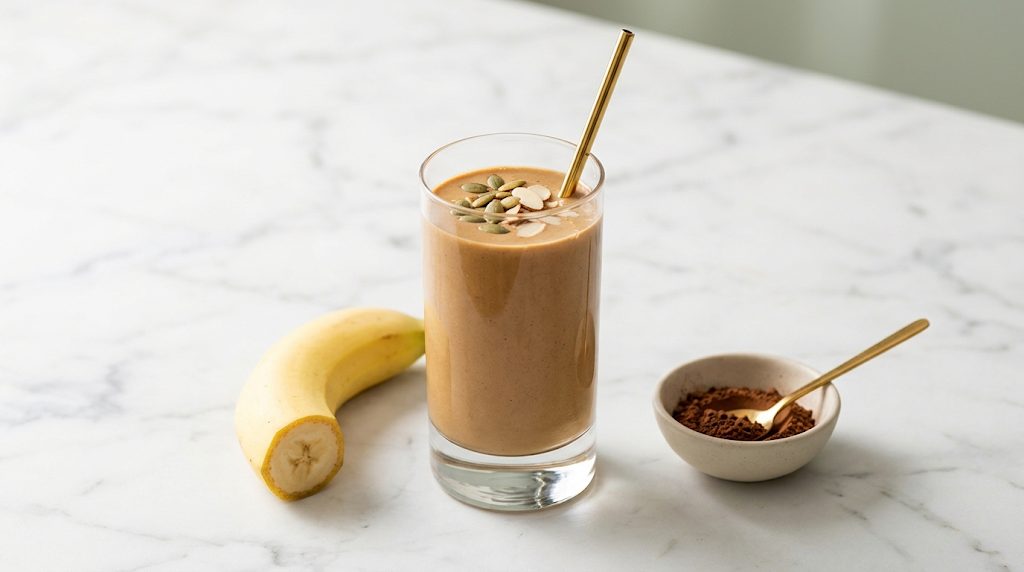
Fancy a tasty idea? A banana, cocoa and pumpkin seed smoothie ticks all the boxes. You’ll find plenty more ideas in my smoothie recipe ebook.
And if you want to go further on the food side, take a look at my article on the top 4 anti-stress foods.
L-tryptophan: what I loved
- ✅ Effects I felt fairly quickly, from the first week
- ✅ A clearer mind, less brain fog
- ✅ Stress that weighs on me much less
- ✅ Much calmer digestion: my gut no longer suffers from my stress
- ✅ A feeling of being better in my body and more present
- ✅ A simple supplement that fits easily into daily life
Precautions to know before you start
L-tryptophan is natural, but natural doesn’t mean risk-free. Here are the important points.
- ⚠️ Taking an antidepressant? Don’t combine it with tryptophan without medical advice. With some treatments (SSRIs, MAOIs…), there’s a risk of serotonin syndrome, an excess of serotonin that can be serious.
- ⚠️ The same caution applies to other treatments that act on serotonin, such as some migraine medications, or St John’s wort.
- ⚠️ Pregnant or breastfeeding? Supplementation is not recommended.
- ⚠️ Irritable bowel syndrome with a tendency towards diarrhoea? Ask your doctor first (see the digestion section above).
- ⚠️ Avoid combining several supplements aimed at mood or sleep at the same time.
- ⚠️ Choose a quality product and stick to the dose shown on the packaging.
The simplest thing? Talk to your doctor or pharmacist before you start. Especially if you’re on any treatment.
Why I recommend giving it a try
I think many of us could benefit from it, to a greater or lesser extent. Stress is part of modern life, and our mood often pays the price.
Every body is different. To find out whether L-tryptophan suits you, the best way is still to try it, with the precautions mentioned above. Notice how you feel after one or two weeks.
In conclusion
L-tryptophan has been a wonderful discovery for me. Less stress, a clearer mind, and the feeling of being myself again. Not bad for such a little-known amino acid!
What about you? Had you heard of L-tryptophan? Have you tried it? Tell me about your experience in the comments, I can’t wait to read them 💛
This article shares my personal experience. It does not replace the advice of a health professional. No partnership: I’m not paid to talk about it.


Leave A Reply